
Dr. Michio Hirano, a leading expert on thymidine kinase 2 deficiency (TK2d), has received one of the Muscular Dystrophy Association’s highest honors: the MDA’s 2026 Legacy Award for Achievement in Clinical Research.
Dr. Hirano, a neurologist at Columbia University Irving Medical Center in New York, was given the award March 9, 2026, by the MDA’s president and CEO, Sharon Hesterlee, during the organization’s recent clinical and scientific conference in Orlando, Florida.
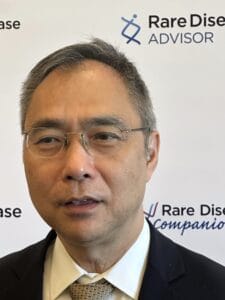
“Dr. Hirano’s pioneering work in mitochondrial and neuromuscular science has shaped decades of progress,” Hesterlee said in announcing the award.
Dr. Hirano told Rare Disease Advisor (sister site to TK2d Companion) that he was recognized for his contributions on TK2d and another rare ultrarare disease, mitochondrial neurogastrointestinal encephalomyopathy (MNGIE). He’s also conducted clinical trials on a rare form of limb-girdle muscular dystrophy.
“I have been working with the MDA in their clinic for nearly four decades,” said Dr. Hirano, who grew up in New York City as the son of Japanese immigrants. “I’ve served on their scientific advisory board and have even volunteered in their summer camps, and have been the beneficiary of MDA grants that have supported our research in mitochondrial diseases, including TK2d.”
Dr. Hirano’s research has included the development of a TK2-deficient mouse model and research on deoxynucleoside therapy. In November 2025, the U.S. Food & Drug Administration approved doxecitine and doxribtimine (Kygevvi) as the first and only treatment for TK2d. The drug, developed by Belgium’s UCB, is specifically authorized for patients with symptom onset on or before 12 years of age.
Dr. Hirano said UCB has identified 253 cases of TK2d worldwide, though many of those patients have since died.
“Additional patients have certainly been identified since then, and many have not yet been diagnosed” he said, adding that up to 600 adults could be surviving with the disease — especially those who are less severely affected.
“I’m a translational researcher, so I see patients and do laboratory work, and they’re tied together. The patients I see in the clinic often are the subjects of my research. I take skin biopsies, so I’m able to bring them to the laboratory and work on them in the lab. I have the unusual ability to go back and forth between the clinic and the bench.”
Dr. Hirano said he’s “humbled and flattered” that MDA chose to honor him for his research on TK2d.
“This has been an extraordinary journey — from testing a therapy in a mouse to delivering it to patients and now getting it approved,” he said. “We’re very excited that we can deliver this therapy now to more patients, and hope we can do this for other diseases as well.”
Listen to an interview with Dr. Michio Hirano on Rare Disease Advisor: An Interview With Dr. Michio Hirano, a Global Expert on Thymidine Kinase 2 Deficiency
Sign up here to get the latest news, perspectives, and information about TK2d sent directly to your inbox. Registration is free and only takes a minute.